Tuesday, May 15, 2012

All The Parts Of The Caladium Bicolor Contain Toxic Substances


Caladium Bicolor
The Caladium bicolor (Aiton) Vent. (1801) is native to the open forests of tropical South America (Brazil, Colombia, French Guyana, Guyana, Surinam and Venezuela), in areas characterized by evident seasonal changes.

It seems that the name of the genus is the Latinization of the name in Malay language “kaladi”; the name of the species comes from the Latin “bicolor” = of two colours, with obvious reference.Common names: “caladio”, “caladium” (Italian); “angel wings”, “elephant’s ear”, “fancy-leaf caladium”, “heart-of-Jesus”, “mother-in-law plant” (English); “caladium”, “palette de peintre” (French); “caladio”, “coração-de-Jesus”, “papagaio”, “tajà”, “taià”, “tajurà”, “tambatajà”, “tinhorão” (Portuguese); “alas de angel”, “caladio”, “capotillo”, “corazon de Jesus”, “manto de la reina”, “orejas de elefante”, “paleta de pintor” (Spanish); “Buntblatt”, “Buntwurz”, “Kaladie” (Ger- man).

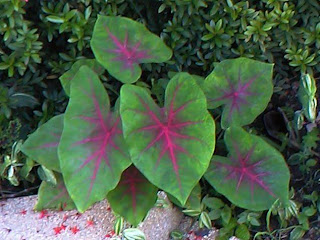
Deciduous, rhizomatous, perennial herbaceous, with peltate, sagittate or hart-shaped leaves, of various tones of green and variously spotted, veined and dotted of red, pink and white, 20-40 cm long and 10-20 cm broad on fleshy petioles, long up to about 60-70 cm, directly from the rhizomes.

The inflorescences, rather negligible and shorter than the leaves, are formed by a 6-10 cm long spadix, narrowed in the median part, contained in a yellowish white spathe tending to the green at the base; the flowers are unisexual, the masculine ones occupy the upper part of the spadix for 3-5 cm of length, the feminine ones are grouped in the lower part for 1-2 cm of length, separated from the masculine ones by a sterile zone of about 2 cm.

Plant poisoning is caused by chemicals in plants that have undesirable affects upon animals and humans. Some poisons must be ingested whereas others, such as chemicals in poison-ivy, only require contact to elicit response in sensitive humans. Some chemicals must be modified before they are poisonous to animals, such as prunasin and other cyanogenic glycosides.

Plants that cause dermatitis are discussed in this program if the reactions are severe. The more obscure dermatologic plants are not included. For more information on plant-induced dermatitis [see Mitchell, J. C., Rook, A. 1979. Bota
nical dermatology. Greenglass Ltd, Vancouver, B.C., Canada. 787 pp.].

Other excluded plants are those that only cause mechanical injury, poisonous blue-green algae, and plants causing hay fever.

While the Information System is oriented primarily to a Canadian audience, much of the information is useful elsewhere. Certainly the plants grown in and around homes can be grown throughout the temperate regions of the world. Indeed, many house plants are tropical in origin. Other plant species included here have been introduced to North America as well as other temperate regions of the world. The information on the native plant species is applicable wherever they grow in North America.

Elsewhere, it is cultivated as annual, pulling out the tubers from the ground in autumn, as soon as the leaves have fallen, in order to conserve them in sand or other inert material in a dry and ventilated location, with temperatures not lower than +12°C, treating, if the case, with fungicides, and to enter them again by the beginning of spring, when the temperatures are favourable.

The plant, more particularly its countless hybrids and varieties, is also cultivated, since long time, in pot for indoor decoration, paying attention to keep constantly humid the substratum during the vegetative period, and to stop completely watering during the resting time, when the plant loses its leaves, and resuming them after the vegetative recommencement.

All the parts of the plant contain toxic substances, particularly calcium oxalate, which can cause reactions, even serious, if chewed and swallowed.

Friday, May 4, 2012

The Bloodberry Plant Is Poisonous, Especially The Leaves


bloodberry
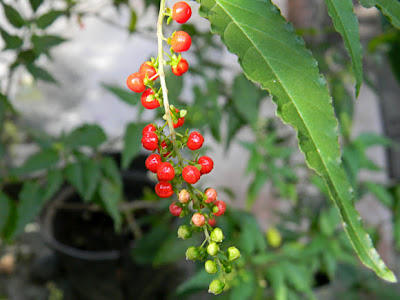
Description Perennial herb, sometimes woody at the base, 300-900 mm high with spreading branches; finely hairy when young. Leaves light green, thin textured, ovate to ovate-elliptic, on long slender petioles. Flowers, white or greenish to rosy, small, in slender, loose, many-flowered racemes. Flowering time from October - June or all year. Fruits, glossy, bright red berries, with one hairy seed per fruit. a species of flowering plant in the pokeweed family, Phytolaccaceae, that is native to the Americas. It can be found in the southern United States, the Caribbean, Central America, and tropical South America. Common names include Pigeonberry, Rouge.


Herbaceous bushy perennial standing up to 120cm (4ft), sometimes woody at base; leaves ovate to oblong, thin, to 3-10cm (1-4in) long, petioles slender; racemes slender, loose, to 20cm (8in) long and have wavy margins; flowers pink to white flowers grow on a spike measuring 3-5cm (1-2in) in length; the top of the spike has reddish-pink buds and the base has bright red to orange fruit, 5mm in diameter. Rivina humilis blooms from May to October. Grows well in the Caribbean and tropical America.

  
Distribution Native to North, Central and South America and West Indies. It is widely naturalized in Indo-Malesia and the Pacific Islands. In Australia it invades rainforest margins and shady places and in other islands like Fiji, it occurs in coastal areas and along roadsides. Rivina humilis
  
Habit at Ualapue, Molokai - Credit: Forest and Kim Starr - Plants of Hawaii - Image licensed under a Creative Commons Attribution 3.0 License, permitting sharing and adaptation with attribution.
  
How it Spreads Bloodberry spreads mainly by seed. The attractive bright red colour of the seeds makes the rivina a choice food for many kinds of birds which allows seeds to be easily dispersed. For small infestations, seeds can be collected and destroyed. Plants with no seeds can be hand-pulled and hung up to dry. Seed heads can be removed to minimize new growths. Ideally control should be done before the plants have the chance to form berries and/or flowers. There are no herbicides registered for this plant in South Africa. Rivina humilis
  
Flowers fruit and leaves at Ocean Ridge Hammock Park, Florida - Credit: Forest and Kim Starr - Plants of Hawaii - Image licensed under a Creative Commons Attribution 3.0 License, permitting sharing and adaptation with attribution.
  
History in South Africa Blood berry was introduced to South Africa as an ornamental. The earliest record is a specimen in Pretoria National Herbarium collected in 1944 at Lower Tugela in Stanger, KwaZulu-Natal and in 1946 at Queens Park in East London, Eastern Cape. Its color comes in the form of soft pale pink flower spikes followed by bright red berries, often with several clusters of each covering the plant. The berries are loved by birds and deer seem to leave the plants alone as well. If Pigeonberry is not watered during extreme drought it may go dormant and return later. Other names for this plant are, Rouge Plant and Baby Peppers though it isn't edible.
  
Environmental and economic impacts Bloodberry is a dwarf-like plant hence the species name humilis, and is shade tolerant. It threatens plants that grow at lower altitude in forests. Following disturbance of natural vegetation, this plant interferes with the re-establishment of native forest vegetation as it forms dense monocultural stands. All parts of the plant are poisonous, especially the leaves. Although birds will eat the berries, they are somewhat poisonous to humans.   

Stem
  
Usually flowers and fruits as a shrub about 1 m tall but can flower and fruit when much smaller.
  
Leaves
  
Leaf blades about 4-12 x 1.5-4 cm, petioles about 1-3.5 cm long. Leaf blade quite thin, wilting quickly when picked. Twigs glabrous, longitudinally grooved, rather pithy. Scattered pale-coloured hairs usually present along the midrib on the underside of the leaf blade. Petiole with two rows of glandular hairs on the upper surface.
  
Flowers
  
Racemes erect, glabrous, about 4-12 cm long, pedicels about 2-3 mm long at anthesis, subsequently elongating. Tepals about 2-2.5 mm long, glabrous. Anthers glabrous.Ovary subglobose, glabrous, style short with an extension running down the side of the ovary.
  
Fruit
  
Fruits bright red, about 3.5-4 mm diam. Testa brown, surface hairy. Embryo horseshoe-shaped, surrounding a central pocket of endosperm, cotyledons rolled longitudinally like a cigar.
  
Seedlings
  
Cotyledons orbicular to almost cordate, glabrous, about 9-11 mm diam, petiole about 8-10 mm long, almost as long as the cotyledon. At the tenth leaf stage: leaf blade lanceolateor broadly lanceolate, petiole almost as long as the leaf blades. Upper surface of the petiole, near its junction with the leaf blade, densely clothed in short, glandular (?) hairs.Petiole grooved on the upper surface.
  
Distribution and Ecology
  
An introduced species originally from tropical America, now naturalized in CYP (Torres Strait Islands), NEQ and southwards as far as north-eastern New South Wales. Altitudinal range from near sea level to 900 m. Usually a weed associated with man-made or modified vegetation types but also grows in disturbed areas in lowland and upland rain forest and monsoon forest. Also found in closed vegetation types near the sea. Also occurs as a pantropic weed.
    
By cultivation it has been distributed through not only all tropical and subtropical regions, but also in many of the temperate countries of the globe. The valuable purgative known as castor oil is the fixed oil obtained from the seeds of the castor oil plant. Besides being used medicinally, the oil is also employed for lubricating purposes, burning and for leather dressing.
  
It is very variable in habit and appearance, the known varieties being very numerous, and having mostly been described as species. In the tropical latitudes most favourable to its growth, it becomes a tree 10-12m (30-40ft) high.
  
The handsome leaves are placed alternately on the stem, on long, curved, purplish foot-stalks, with drooping blades, generally 12-18cm (6-8ins) across, sometimes still larger, palmately cut for three-fourths of their depth into seven to eleven lance-shaped, pointed, coarsely toothed segments. When fully expanded, they are of a blue-green colour, paler beneath and smooth; when young, they are red and shining. The flowers are male and female on the same plant, and are produced on a clustered, oblong, terminal spike. The male flowers are placed on the under portion of the spike; they have no corolla, only a green calyx, deeply cut into three to five segments, enclosing numerous, much branched, yellow stamens. The female flowers occupy the upper part of the spike and have likewise no corolla. The three narrow segments of the calyx are, however, of a reddish colour, and the ovary in their centre is crowned by deeply-divided, carmine-red threads - styles.
  
The fruit is a blunt, greenish, deeply-grooved capsule less than an inch long, covered with soft, yielding prickles in each of which a seed is developed. The seeds of the different cultivated varieties differ much in size and in external markings but average seeds are of an oval, laterally compressed form. The smaller, annual varieties yield small seeds- the tree forms, large seeds. They have a shining, marble-grey and brown, thick, leathery outer coat, within which is a thin, dark-coloured, brittle coat. A large, distinct, leafy embryo lies in the middle of a dense, oily tissue (endosperm).
  
Description: The flowers are in slender terminal racemes. The individual flowers are small and have 4 rounded, pink, white, or green sepals. The round, red berries contain a red dye and are often present at the same time as the flowers. The leaves are green, petiolate, and ovate, lanceolate, or triangular in shape. The stems are slender.
  
Special Characteristics
  
Poisonous – The entire plant is poisonous, especially the leaves. Although birds will eat the berries, they are also somewhat poisonous to humans.
Saturday, April 28, 2012

Mimosa Pudica, The Sensitive Plant Can Thrive In One Of Two Types Of Life Cycles

mimosa pudica
Mimosa pudica, also known as sensitive plant or sleeping grass, is a small, short-lived, perennial most valued for its interesting foliage. The plants are not tolerant of cold temperatures and die back when exposed to frost. In the United States, Mimosa pudica is grown most frequently as a houseplant, where its growing environment can be strictly controlled, or as an outdoor annual. In tropical climates, the plant may become weedy or invasive when not controlled.
  
Mimosa pudica requires full sun to partial shade and rich, moist, well-drained soil to thrive. When growing in containers, a soil mixture made of two parts peat moss, two parts loam and one part sand is recommended to provide adequate drainage and fertility. Weekly watering keeps the soil moist but not soggy, which sensitive plant prefers. Plants benefit from weekly fertilizing during the spring and summer months using a balanced fertilizer diluted to half-strength, but feeding should be reduced to one per month during winter. Mimosa pudica needs warm growing conditions and temperatures should not drop below 65 degrees Fahrenheit or yellowing of leaves and stems may occur.
  
The methanolic extract of leaves of Mimosa pudica at the dose of 200mg/kg body weight per oral was studied for the hepatoprotective effect using Carbontetrachloride induced liver damage in wistar albino rats. Methanolic extract showed significant (p<0.05) hepatoprotective effect by lowering the serum levels of various biochemical parameters such as serum glutamic oxaloacetate transaminase (SGOT), serum glutamic pyruvates transaminase (SGPT), alkaline phospatase (ALP), total bilirubin (TBL), total cholesterol (CHL) and by increasing the levels of total protein (TPTN) and albumin (ALB), in the selected model. These biochemical observations were inturn confirmed by histopathological examinations of liver sections and are comparable with the standard hepatoprotective drug Silymarin (100mg/kg bodyweight i.p.) which served as a positive control. The overall experimental results suggests that the biologically active phytoconstituents such as flavonoids, glycosides alkaloids present in the methanolic extract of plant Mimosa pudica, may be responsible for the significant hepatoprotective activity and the results justify the use of Mimosa pudica as a hepatoprotective agent.
  
Mimosa pudica is best propagated from seed. For the best results, soak seeds in warm water overnight or until they become swollen, and sow immediately in seed-starting soil mix, covering with soil two to three times their thickness. Keep the growing medium moist at all times. Do not over-water or allow it to dry out completely. Place in bright light and wait for germination, which takes two to three weeks at 70 degrees Fahrenheit. Transplant into pots when seedlings reach about 4 inches in height, and resume regular care for the remainder of the plant's life.
  
Mimosa pudica is an evergreen sub-shrub that reaches no larger than 5 feet in height and produces small, globe-shaped flowers in summer. The plant's most fascinating feature is its fern-like leaves that close and fold up when touched. This reaction is known as a seismonastic movement, or a physical reaction to shock. At night, the leaves also close as a reaction to the absence of light, which is known as a nyctonastic movement. The plant's common name derives from this sensitivity to outside stimuli.
  
In young plants, the Mimosa pudica has erect stems that transform to 5-foot long creeping or trailing stems. Pale, lilac pink flowers in summer look like fluffy balls, yet each cluster holds individual flowers. Leaves of most species are bipinnate, where leaflets give rise to other leaflets. The sensitive plant folds its foliage at dark and reopens in light. Fruit consists of two to eight pods. Each pod holds brown seeds. Certain species have poisonous roots.
  
The sensitive plant can thrive in one of two types of life cycles: as an indoor annual ornamental with showy flowers; as an outdoor perennial plant in the tropics. Habitat includes moist, waste ground, open plantations, and well-drained soils with open sun. The Mimosa pudica can exist as a dense ground cover, with thorny stems that make grazing difficult and prevent reproduction of other species. The sensitive plant is drought and frost tender, and sensitive to over-watering. On dry, wild lands, this plant poses a fire hazard.
  
A fungus distributed by the soil, Fusarium oxysporum, enters through the plant roots, and blocks the vascular or water conducting system. This fungal pathogen prevents the transportation of vital water and nutrients to the leaves. Wilting and death can result.
  
Mimosa vascular wilt disperses by wind, water, animal actions, birds and human activities. Disease spreads from infected trees to healthy trees. With no known cure for mimosa vascular wilt, avoid spreading the fungus, such as by moving the soil. If the mimosa is in tree form, remove and destroy the trees by burning.

Sunday, April 22, 2012

Gardenias Which Have A Fresh Calming Fragrance Are Symbolic Of The Spirit Of Motherhood


gardenia
If you are among those people who have been searching for a plant that has an amazing fragrance, then you definitely have found it in the gardenia . For anyone blessed with a green thumb, your gardenias are going to be items of beauty with their white-colored scented blooms. This particular plant grows fastest in tropical climates. So if you reside in a tropical climate, gardenias should be abundant.There are a lot of people out there that have no luck with growing gardenias but then there are still those few that have very good luck with growing gardenias. Sounds to me like you have some magic powers when it comes to growing plants. At least when it comes to plants that no one else can grow. Let's first agree that although these Gardenia flowers sparkle like moondust with their pure white petals, although they send off a thick unforgettable fragrance so enchanting it goes right into perfume, growing them is pure science.Gardenia is a genus of flowering plants comprised of about 142 species belonging to the family of Rubiaceae.

Gardenias are evergreen shrubs which can grow from two to twenty feet or more in height in their natural habitat. The leaves are glossy, dark green growing from about one to ten inches long depending on the species. Gardenia flowers are white or yellow in color and develop either a single or a cluster of blossoms. The flowers of many species are known for their intoxicating sweet scent.

Gardenia taitensis, also called Tahitian Gardenia and Tiare Flower, is one of only a few plants indigenous to Polynesia. This evergreen tropical shrub can grow as tall as twelve feet. The flowers are white, composed of five to nine petals and very fragrant.Inhabitants of Polynesia use these highly fragrant flowers as necklaces. These floral necklaces are called "Ei" on the Cook Islands, "Hei" on Tahiti and "Lei" on Hawaii.On some Pacific islands wearing these gardenia flowers indicates one's relationship status. When the flower is worn on the right ear, the person is available. When the flower is worn on the left ear, the person is taken.

The flowers of Gardenia taitensis are used to make Monoi Tiare Tahiti, which is a perfume oil, by infusing the flowers in coconut oil. This process is called "Enfleurage". The process uses odorless fats that are solid at room temperature to capture the fragrant compounds released by plants.In addition, the flowers are also used in highly priced perfumes, like Tiare by Ormonde Jayne and Tiare by Chantecaille.Other popular Gardenia species include Gardenia brighamii, Gardenia cornuta and Gardenia nitida, to name a few.

Gardenia plants prefer partial sun and should be protected from the hot afternoon sun during the summer months. They grow and flower well under grow lights where night temperatures should not go below 60 to 65 degrees which translates to 15 to 18 degrees Celsius.

No fuss, no muss. And you can get up close and personal with your Gardenia, you can eat your Gardenia, and there will be nothing poisonous there to make you sick. I love that most of all. If you keep your Gardenia potted, it will most certainly dry out very quickly. Growing one of these is not like growing them indoors. The great outdoors is full of surprises, and these Gardenias do not take dry soil kindly. Watch it very carefully if you do that. I do believe however the fresh air is good for everyone after a winter indoors.

Tuesday, April 17, 2012

Cactus One Plant Named "Children Of The Sun"

Cactus
Most of the Cactuses are thorny plants, no water lover, but being precious in full light. Therefore the cactus plants were called "children of the sun".

During the summer, keep your cactus outside; thorny cactus loves sunshine, the cactus with few thorns has to stay in light, without sun. Put the cactus with no thorns in semi-light. As a trick, we recommend you to add in pot over the soil some small river stones .which are very helpful in the hydrating and moisture process. In this case, you don't have to water it, just maybe spray the soil.In winter, the plants have to be kept in light places with moderate temperature (10-12 degree centigrade). The watering will be rare, maybe once in two weeks. Our advice is not to water it. Anyway, if you do it, don't reach the plant.

There are hundreds of varieties perfectly suited for you home. Every species comes with its own specific care instructions and needs. It is important to find out from the nursery or wherever you bought your cactus just exactly how to care for the plant. Most are relatively low maintenance but some of the more exotic species have specific and exacting requirements.

The most common cause of death of all cacti is not watering them properly. When you plant your cactus cutting, do not water it for about two to four weeks. Then, water your cactus cutting every 2-3 weeks. It's important to remember that cacti thrive in the desert and that there's not much water in the desert. So, do your cactus a favor and treat it like it's in the desert.

 As a trick, let in free air the cutting to heal it self for a few days, then pot it in sand. Keep it without watering, just spraying sometimes, in warm and light shady place.