Tuesday, August 18, 2015

Gardens: what to do this week

Clematis 'Big Brother': 'Its blooms are mammoth.'

Visit this


Whether you’re mad for mahonia or crazy about chrysanthemums, the national collection of your favourite plants is somewhere in the UK. Conservation charity Plant Heritage supports more than 600 national collections, helping to keep threatened plants in cultivation and promote biodiversity in our gardens.

Revive this


You planted a hydrangea, it flourished all spring, but now on hot days its leaves are wilting. Hydrangeas are the first plants in the garden to suffer when the soil dries out. Give them a long drink, then mulch heavily; if they still sulk once established, move to a moister spot come winter.

Plant this

Breeders just can’t leave clematis alone, resulting in ever-bigger blooms that won’t collapse at the first drop of rain. Join the clematis revolution by investing in new variety ‘Big Brother’. At 25cm across, its blooms are mammoth; even better, it flowers twice, in late spring and late summer. Height and spread 1.5m x 90cm. To order one jumbo plug for £14.99, or two jumbo plugs for £19.99, call 0330 333 6856 quoting ref GU359. Or shop online at theguardian.com/offers/plants. All orders include free p&p. Dispatched August to September.

Monday, July 13, 2015

Gardens: seasons in the sun


Drying game: evening primrose. Photograph: Alamy
I am blessed with our soil here – two generations ago the land was market gardens that provided fruit and veg for Bath. When there’s enough rain to keep the hearty south-facing slopes moist, my plants grow athletically, and I have to keep them in check.

In a dry summer such as this, however, our sunny slopes provide challenges. My American swamp lilies are half the height they should be and even though the hellebores are snuggled in the shade of the willows, their rosettes are splayed with thirst.

When building the new vegetable garden, I included a water-harvesting tank to save rainwater from the barn’s roof. Harvesting water is a discipline I encourage my clients to build into their gardens, to raise awareness that it is a finite resource, and also because rainwater is better for your plants.

Bronze fennel. Photograph: Alamy
I made the new vegetable garden by cutting into the land and creating a terraced bank. The steep rubbly slopes that fall away are made with the subsoil from the excavations and sown with a wild-flower mix, which as I write is in its first summer and filled with bees. The wild flowers prefer the poor soil to our rich ground and the grasses are lovely when they dry to tawniness.

Beyond the garden, between two outbuildings, is an area that was backfilled with brash to provide dry access to the compost heaps beyond. The pockets of soil up close to the buildings were given to plants that would do better in good ground.

‘Miss Willmott’s Ghost’. Photograph: Alamy
Being hungry for as many different habitats on the land here, I didn’t add any topsoil to the areas either side of the path. I wanted a contrast to the heartiness elsewhere, and selected a range of plants that would thrive in the free-draining ground. Sea kale, with its young foliage the colour of red cabbage and later sprawl of honey-scented flowers, Baptisia ‘Chocolate Chip’, in dusky tones that suit the rusted tin, and a good hybrid Phlomis called ‘Edward Bowles’. This is creamy yellow like its parent P russelliana, but takes on a semi shrubby form from P fruticosa. Euphorbia ‘Copton Ash’ is new to me with low, glaucous foliage and lime-green flowers. Drifting, as if self-sown, crimson Dianthus cruentus, lilac Centranthus locoqi and Beupleurum perfoliatum mingle throughout.

I planted openly to broadcast a seed mix I’d made up of plants that I knew would take to the dry, loose shingle. Evening primrose, bronze fennel, sweetly scented Matthiola incana ‘Alba’ and ‘Miss Willmott’s Ghost’, Eryngium giganteum. Beth’s poppy, a gift from Fergus Garret at Dixter, passed in turn to him from Beth Chatto from her dry garden was already up and rejoicing in the stony ground this April. It is a nice reminder of Beth’s mantra: the right plant in the right place, and you can enjoy a dry summer.

Get growing

When planting a dry position do so when there is moisture around, in the spring or autumn. Soak the pots in water until the bubbles stop rising to the surface, and try to have courage to let the plants find their way thereafter.

Monday, June 29, 2015

Green-fingered teachers: how to grow fruit and vegetables in school


Photograph: Green Bronx Machine
There’s nothing more satisfying than harvesting your own crops at school. As the first plums of the season ripen on trees and tiny cabbages appear between leaves, students can feast both their eyes and their bellies, on the fruits of their labour.

But there are also a wide range of educational benefits to going green, from teaching about photosynthesis and the life of a plant to seasonal poetry and creative writing, the topic can be explored in a variety of classes.

If you’re interested in greening up your classroom or designing a wild space somewhere on the school grounds, there’s a lot to consider. Here’s our guide for getting started:

When growing plants indoors keep it simple and start small, according to teacher Stephen Ritz from Discovery high school.

Ritz, who is famed for his pioneering indoor farming project the edible classroom, recommends easy-to-grow crops such as lettuces, beans or peas, or growing your own classroom herb garden. These vegetables are the best choice and are easy to take care of. They can be grown in pots on windowsills where they can get plenty of sunlight and need regular water.


Beckie Taylor, a teacher from Manor primary school in Coseley, grows pumpkins which can be planted from April onwards in small disposable cups. They also need regular water and sunlight. Once they are large enough they can be moved to growbags outside.

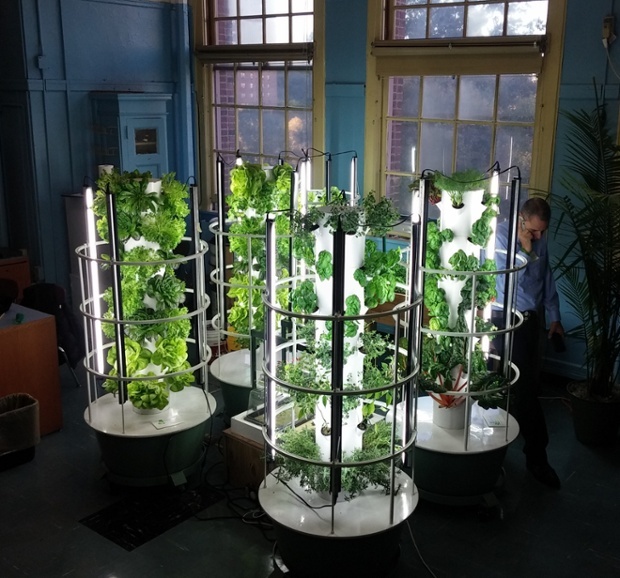
Cups and pots are great to grow in, says Ritz, but he also recommends the Tower Garden by Juice Plus – a vertical aeroponic growing system that lets you grow upwards, saving space.

To make sure your crops are tended to, Taylor suggests putting up a chart to keep track of what the plants need and when. “Children can mark off when they have been watered in order to avoid neglect or over watering,” says Taylor.

It’s also vital to make sure there’s someone to watch the plants over the holidays. Ritz plans ahead so things sprout during term time. However, if this doesn’t work out he says there’s nothing wrong with sending plants home for eager young gardeners to look after.

Taylor has some words of warning: “You will need to ensure the space chosen [to grow plants] is away from important work in the classroom, such as books and displays of work. It also may be hard to control the conditions needed in the classroom.”


First find a good growing spot. This isn’t always easy but by law schools must have suitable outdoor space for playing team games. “If schools are committed to growing vegetables then they are not going to mind losing bits of their sports field for veg beds,” says Mel Jacob, who works for the outdoor education company Poppies & Parsnips.

If your school does lack space, Jacob recommends quick-crops such as carrots that can grow in old welly boots, buckets and containers.

She adds: “I think that schools can apply for allotments and the council can be supportive of this but they need to be close by to the school or else too much time is taken up walking to the allotment .”

Once you’ve got the land sorted, she says, you cannot be too precious about the growing bit. “It’s not going to look like Chelsea flower show; children tend not to plant in straight lines.”
Fruit is a good choice for outside growing, and berries of various kinds (strawberries and blueberries) grow well.

Felicity Plent, head of Education at Cambridge University Botanic Garden recommends a new dwarf raspberry from Thompson & Morgan called “Ruby Beauty” , which is suitable for growing in small spaces or a container and is likely to give crops before the end of the summer term.

Don’t worry too much about when to start planting because different vegetables grow at different times, says Jacob. Even when the growing season ends you can get active with things like minibeast hunts or making garden structures and Christmas wreaths with children in winter.

There’s lots of ways to link all this with the curriculum. With younger gardeners, key stage 1 and 2 English spoken language can be practised and vocabulary developed. “Encourage the use of adjectives to describe plants and objects around the garden, taste, sound, texture. Use of descriptive vocabulary as a class to create poems,” advises Plent.

She adds that you can use it in science class too, identifying living things and their habitats with primary students, getting your class to name a variety of plants and discuss simple food chains.
Gemma Cahill, a teacher at Blackburn Central high school, says that you can teach older students skills that can help their future job prospects.

For example, you can teach about science, technology, engineering and maths (Stem) careers by getting your secondary class to run their own blind test of organic and non-organic foods to see if they can tell the difference between the two. Explore what it would be like to work as a product manager for a company growing herbs for major shops and supermarkets. Science & Plants has more information about this investigation here, and other resources for secondary students on their website.

Lots of organisations offer free tools to help you get started. Get in touch with Grow Wild to get free wildflower seeds – they have currently run out but will have more in the autumn next year. The Woodland Trust also has a free school tree pack. Thompson & Morgan, one of the UK’s largest mail order seed and plant company have put together some top tips on getting the most from a small space.

If you’re looking for teaching resources to help you link growing with the curriculum, you can find useful resources for teachers on the Royal Horticultural society’s website. Garden Organic also has lots of useful resources and tips for getting started as does Food for Life. If you’re keen on using the topic in science class then check out Science and Plants for Schools.

Monday, June 15, 2015

Let’s move to Dedham Vale, Nayland and East Bergholt, Essex and Suffolk

Let's move: Dedham Vale
What’s going for it? Every day, crowds of Reggie Perrins pour out of commuter trains at Manningtree. London is just – just – about commutable from here if  the job at one end, and the paradise at the other, are worth the slog. Dedham Vale, they have judged, is worth it. Those commuters have been bred on a fantasy of unchanging English rural life in the lower Stour valley since John Constable picked up his paints: lush, juicy watermeadows, gnarly oaks, rampant wisteria and ickle villages painted like a jar of boiled sweets in Suffolk pinks, oranges and custard yellows. Constable’s paintings have seeped so much into the collective unconscious that everywhere your eye rests seems vaguely familiar. It has all been preserved just – just – the right side of twee, which, of course, is ironic, as Constable’s paintings were shocking for their depiction of the humdrum, ordinary working landscapes of their day. Dedham Vale is now a modern working landscape, of sorts, a kind of reverse Dorian Gray. The perfect picture remains the same, as those commuters, home at last, slowly age.
The case against Crowds. Come May, the coach parties from Shenzhen arrive and stay until autumn. If you commute, think of it as a daily timeshare: you go, they arrive, they go, you get home. But you can find quieter spots, westwards. I have a problem with perfection, but that’s just me.
Well connected? Yes. Trains: four an hour to Liverpool Street (65-75 min), three to Ipswich (13 mins) and two to four to Chelmsford (around 30 mins). Driving: the A12 passes through, making Colchester and Ipswich 20 mins; the coast at Walton or Felixstowe is 40 mins.
Schools Primaries: many rated “good” by Ofsted, with Nayland, Boxford CofE, Bures CofE and Dedham CofE “outstanding”. Secondaries: East Bergholt High is “good”.
Hang out at… The Sun Inn at Dedham is a stunner. For quieter pints, The Crown in Stoke by Nayland.
Where to buy Anywhere. There’s timber-framed manors, Georgian farmhouses, thatched cottages, Queen Anne. Dedham is especially pretty. East Bergholt slightly more ordinary. Nayland, away from the crowds, rather a gem. Not everything is cute: 20th or 21st century is cheaper. Detacheds, £250,000-£1.85m. Semis, £200,000-£400,000. Cottages and terraces, £180,000-£375,000. Rentals: few, but a three-bed house, £750-£1,200pcm.
Bargain of the week You’ll be lucky. This three-bed house in Dedham is a little old-fashioned, but it’s vaguely affordable at £300,000 with Palmer & Partners.
From the streets
Michael Munt “Dedham is an Essex gem. My pet hate – snobbish people pretending that the whole area is in Suffolk.”
Cathy Smith “Walk from Manningtree station along the river through Flatford to Dedham, and stand on the spot where Constable painted The Hay Wain. Try Dedham’s Essex Rose tearoom for a cuppa.”
• Do you live in Dedham Vale, Nayland and East Bergholt, Essex and Suffolk? Join the debate below.
Live in the Meon valley, Hampshire? Do you have a favourite haunt or a pet hate? If so, email lets.move@theguardian.com by Tuesday 2 June.

Tuesday, April 7, 2015

How does your garden grow: Pia Ă–stlund of the Chelsea Physic Garden, London

How does garden grow: Pia Ostlund
I grew up on the west coast of Sweden. In Scandinavia, people see the whole of nature as their extended garden. Foraging for berries and mushrooms, fishing and wild swimming are part of daily life.

When I moved to London to study graphic design at Central St Martins, I missed all that. After college, I won a competition to design a garden that demonstrated geological history. With only a small space, I had to engage people’s imagination. I was inspired by William Blake’s line, “To see a world in a grain of sand”. One of the judges was Rosie Atkins, who was then curator of the Chelsea Physic Garden.

I came here 14 years ago, and I still work at least one day a week as a freelance design consultant for the garden. I don’t have a garden at home, but I think of the Chelsea Physic Garden, along with Hackney Marshes, Colombia Road Flower Market and Hampstead Heath, as my extended garden. My role is all about representing the reality of this historic place in interpretive signage, guidance material and merchandising. I have to epitomise what is out there in images.

The garden has given something back to me. One day Rosie showed me an 1855 volume, Ferns Of Great Britain & Ireland, by Thomas Moore, the Victorian curator responsible for our Cool Fernery area. The curious, lifelike – as well as life-size – representations of ferns looked like nothing I had seen before. They were too detailed to be drawn by hand, yet clearly not photographs. Even stranger was the texture of the plants, which could be felt by running one’s finger across the image. Despite having quite a lot of experience of different types of printing, I was at a loss. The only clue was a small caption in the corner of the page that read “Nature Printing”. During the 19th century, there was a hunger for a form of scientific image-making, free from the artist’s hand. A plant was pressed into a sheet of lead under high pressure. This highly detailed impression was copied on to a copper printing plate and used for the mass printing of botanical works. I am close to reviving the method and hope to have an exhibition before long.
My favourite spot

I love the Atlantic Islands greenhouse with its 1930s structure and cast-iron and slate shelving. The plants are strange. They cast beautiful shadows and are totally unsuitable for nature printing, so I can appreciate them without thinking what I can make from them.