Friday, September 18, 2015

Osmanthus

Osmanthus is a genus of about 30 species of flowering plants in the family Oleaceae. Most of the species are native to eastern Asia (China, Japan, Indochina, the Himalayas, etc.) with a few species from the Caucasus, New Caledonia, Sumatra, and North America (Mexico, Central America, southeastern United States)
Osmanthus range in size from shrubs to small trees, 2–12 m (7–39 ft) tall. The leaves are opposite, evergreen, and simple, with an entire, serrated or coarsely toothed margin. The flowers are produced in spring, summer or autumn, each flower being about 1 cm long, white, with a four-lobed tubular-based corolla ('petals'). The flowers grow in small panicles, and in several species have a strong fragrance. The fruit is a small (10–15 mm), hard-skinned dark blue to purple drupe containing a single seed.

Osmanthus are popular shrubs in parks and gardens throughout the warm temperate zone. Several hybrids and cultivars have been developed. Osmanthus flower on old wood and produce more flowers if unpruned. A pruned shrub often produces few or no flowers for one to five or more years, before the new growth matures sufficiently to start flowering.

In Japan, sweet osmanthus (gin-mokusei) is a favorite garden shrub. Its small white flowers appear in short-stalked clusters in late autumn. It has an intense sweet fragrance. A variant with deep golden flowers (kin-mokusei) is also popular.

The flowers of O. fragrans are used throughout East Asia for their scent and flavour, which is likened to apricot and peach.

In China, osmanthus tea (guìhuāchá) combines sweet osmanthus flowers with black or green tea leaves. Traditional Chinese medicine claims that osmanthus tea improves complexion and helps rid the body of excess nitric oxide, a compound linked to the formation of cancer, diabetes, and renal disease.

Osmanthus wine flavours huangjiu or other rice wines with full osmanthus blossoms and is traditionally consumed during the Mid-Autumn Festival.

Tuesday, September 1, 2015

Alys Fowler: the best way to beat weeds

Dandelions are beastly weeds. Photograph: Alamy
Weeds are often thought of as being unpredictable, with an ability to turn up anywhere and take over. In fact, they are quite the opposite: entirely predictable and wholly reliable. Give them bare ground and they will appear; thus, the first rule of weeding is cover your work. If you are not going to be back at that spot for a couple of weeks, cover the soil with cardboard, black plastic, mulch, or sow green manure. Don’t give the weeds a new playground.

All weeds exploit two strategies to reproduce: by spreading stems or roots, or scattering seed. If you can’t get round to weeding out the roots, pull off the flower heads. But be nice; pollinators love weeds that are rich in nectar and pollen. If possible, let them flower, then pull off the flower heads before they set seed. Rot the seed heads down in a bucket before adding to the compost, as immature weed seeds will happily mature on top of the compost heap if they are left with enough flower stalk.

Seeds can travel long distances. They hitch a ride on the wind or a visitor, and arrive unannounced in your garden. Annual weeds rely on this strategy to get anywhere, while perennials can fall back underground to keep marching on. We fear this lot.

The beastly types are brambles (rooting stems), buttercups (runners or stolons – stems that creep along the ground), ground elder and bindweed (rhizomes – subterranean stems), dock and dandelion (tap roots), mare’s tail or Japanese knotweed (both rhizomes) and creeping thistles (spreading roots and seed). If you leave bits of root behind as you dig, they will resprout.

The biggest weeds probably will have to be dug out nonetheless. “Lasagne gardening” – where you layer sheets of cardboard and rough organic matter on top of the soil – can defeat them, or at least loosen the soil, so it makes digging them out a more joyous task. The bigger the weeds, the more layers of cardboard you will need.

Lasagne gardening works better than weed-suppressing membrane because it enriches the soil and doesn’t leach petrochemicals into the ground. Worms love lasagne gardening because it provides them with new food; they don’t feel the same about plastic. Both systems work by weakening plants through lack of light. Some plants with very deep roots keep going for longer than you’d expect, so if in doubt, add another layer. This way you will also bury weed seeds, which tend to need light to germinate.
Advertisement

If that doesn’t appeal, get a goat, rabbits, chickens, or a strimmer. My mother’s battle cry used to be “off with their heads”: eventually, you exhaust the roots.

If your weeds are running through the roots of shrubs or herbaceous perennials, the task is more difficult. Picking at new growth will slow them down, but you must be vigilant to win. Digging up shrubs and perennials in autumn, washing the roots and picking out the offending types is laborious but effective. Glyphosate and the like isn’t nearly as effective as it would like you to think it is.

You should come to your garden in the spirit of generosity to all that grows there.

• Listen to Alys on our gardening podcast at theguardian.com/sowgrowrepeat.

Follow Alys on Twitter

Tuesday, August 18, 2015

Gardens: what to do this week

Clematis 'Big Brother': 'Its blooms are mammoth.'

Visit this


Whether you’re mad for mahonia or crazy about chrysanthemums, the national collection of your favourite plants is somewhere in the UK. Conservation charity Plant Heritage supports more than 600 national collections, helping to keep threatened plants in cultivation and promote biodiversity in our gardens.

Revive this


You planted a hydrangea, it flourished all spring, but now on hot days its leaves are wilting. Hydrangeas are the first plants in the garden to suffer when the soil dries out. Give them a long drink, then mulch heavily; if they still sulk once established, move to a moister spot come winter.

Plant this

Breeders just can’t leave clematis alone, resulting in ever-bigger blooms that won’t collapse at the first drop of rain. Join the clematis revolution by investing in new variety ‘Big Brother’. At 25cm across, its blooms are mammoth; even better, it flowers twice, in late spring and late summer. Height and spread 1.5m x 90cm. To order one jumbo plug for £14.99, or two jumbo plugs for £19.99, call 0330 333 6856 quoting ref GU359. Or shop online at theguardian.com/offers/plants. All orders include free p&p. Dispatched August to September.

Monday, July 13, 2015

Gardens: seasons in the sun


Drying game: evening primrose. Photograph: Alamy
I am blessed with our soil here – two generations ago the land was market gardens that provided fruit and veg for Bath. When there’s enough rain to keep the hearty south-facing slopes moist, my plants grow athletically, and I have to keep them in check.

In a dry summer such as this, however, our sunny slopes provide challenges. My American swamp lilies are half the height they should be and even though the hellebores are snuggled in the shade of the willows, their rosettes are splayed with thirst.

When building the new vegetable garden, I included a water-harvesting tank to save rainwater from the barn’s roof. Harvesting water is a discipline I encourage my clients to build into their gardens, to raise awareness that it is a finite resource, and also because rainwater is better for your plants.

Bronze fennel. Photograph: Alamy
I made the new vegetable garden by cutting into the land and creating a terraced bank. The steep rubbly slopes that fall away are made with the subsoil from the excavations and sown with a wild-flower mix, which as I write is in its first summer and filled with bees. The wild flowers prefer the poor soil to our rich ground and the grasses are lovely when they dry to tawniness.

Beyond the garden, between two outbuildings, is an area that was backfilled with brash to provide dry access to the compost heaps beyond. The pockets of soil up close to the buildings were given to plants that would do better in good ground.

‘Miss Willmott’s Ghost’. Photograph: Alamy
Being hungry for as many different habitats on the land here, I didn’t add any topsoil to the areas either side of the path. I wanted a contrast to the heartiness elsewhere, and selected a range of plants that would thrive in the free-draining ground. Sea kale, with its young foliage the colour of red cabbage and later sprawl of honey-scented flowers, Baptisia ‘Chocolate Chip’, in dusky tones that suit the rusted tin, and a good hybrid Phlomis called ‘Edward Bowles’. This is creamy yellow like its parent P russelliana, but takes on a semi shrubby form from P fruticosa. Euphorbia ‘Copton Ash’ is new to me with low, glaucous foliage and lime-green flowers. Drifting, as if self-sown, crimson Dianthus cruentus, lilac Centranthus locoqi and Beupleurum perfoliatum mingle throughout.

I planted openly to broadcast a seed mix I’d made up of plants that I knew would take to the dry, loose shingle. Evening primrose, bronze fennel, sweetly scented Matthiola incana ‘Alba’ and ‘Miss Willmott’s Ghost’, Eryngium giganteum. Beth’s poppy, a gift from Fergus Garret at Dixter, passed in turn to him from Beth Chatto from her dry garden was already up and rejoicing in the stony ground this April. It is a nice reminder of Beth’s mantra: the right plant in the right place, and you can enjoy a dry summer.

Get growing

When planting a dry position do so when there is moisture around, in the spring or autumn. Soak the pots in water until the bubbles stop rising to the surface, and try to have courage to let the plants find their way thereafter.

Monday, June 29, 2015

Green-fingered teachers: how to grow fruit and vegetables in school


Photograph: Green Bronx Machine
There’s nothing more satisfying than harvesting your own crops at school. As the first plums of the season ripen on trees and tiny cabbages appear between leaves, students can feast both their eyes and their bellies, on the fruits of their labour.

But there are also a wide range of educational benefits to going green, from teaching about photosynthesis and the life of a plant to seasonal poetry and creative writing, the topic can be explored in a variety of classes.

If you’re interested in greening up your classroom or designing a wild space somewhere on the school grounds, there’s a lot to consider. Here’s our guide for getting started:

When growing plants indoors keep it simple and start small, according to teacher Stephen Ritz from Discovery high school.

Ritz, who is famed for his pioneering indoor farming project the edible classroom, recommends easy-to-grow crops such as lettuces, beans or peas, or growing your own classroom herb garden. These vegetables are the best choice and are easy to take care of. They can be grown in pots on windowsills where they can get plenty of sunlight and need regular water.


Beckie Taylor, a teacher from Manor primary school in Coseley, grows pumpkins which can be planted from April onwards in small disposable cups. They also need regular water and sunlight. Once they are large enough they can be moved to growbags outside.

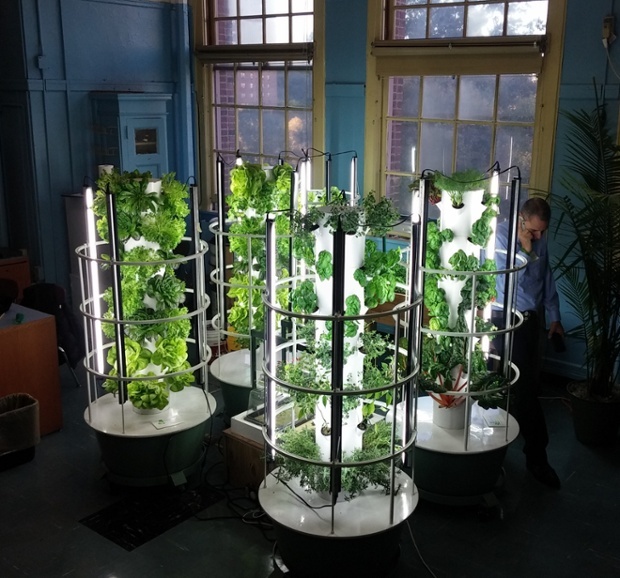
Cups and pots are great to grow in, says Ritz, but he also recommends the Tower Garden by Juice Plus – a vertical aeroponic growing system that lets you grow upwards, saving space.

To make sure your crops are tended to, Taylor suggests putting up a chart to keep track of what the plants need and when. “Children can mark off when they have been watered in order to avoid neglect or over watering,” says Taylor.

It’s also vital to make sure there’s someone to watch the plants over the holidays. Ritz plans ahead so things sprout during term time. However, if this doesn’t work out he says there’s nothing wrong with sending plants home for eager young gardeners to look after.

Taylor has some words of warning: “You will need to ensure the space chosen [to grow plants] is away from important work in the classroom, such as books and displays of work. It also may be hard to control the conditions needed in the classroom.”


First find a good growing spot. This isn’t always easy but by law schools must have suitable outdoor space for playing team games. “If schools are committed to growing vegetables then they are not going to mind losing bits of their sports field for veg beds,” says Mel Jacob, who works for the outdoor education company Poppies & Parsnips.

If your school does lack space, Jacob recommends quick-crops such as carrots that can grow in old welly boots, buckets and containers.

She adds: “I think that schools can apply for allotments and the council can be supportive of this but they need to be close by to the school or else too much time is taken up walking to the allotment .”

Once you’ve got the land sorted, she says, you cannot be too precious about the growing bit. “It’s not going to look like Chelsea flower show; children tend not to plant in straight lines.”
Fruit is a good choice for outside growing, and berries of various kinds (strawberries and blueberries) grow well.

Felicity Plent, head of Education at Cambridge University Botanic Garden recommends a new dwarf raspberry from Thompson & Morgan called “Ruby Beauty” , which is suitable for growing in small spaces or a container and is likely to give crops before the end of the summer term.

Don’t worry too much about when to start planting because different vegetables grow at different times, says Jacob. Even when the growing season ends you can get active with things like minibeast hunts or making garden structures and Christmas wreaths with children in winter.

There’s lots of ways to link all this with the curriculum. With younger gardeners, key stage 1 and 2 English spoken language can be practised and vocabulary developed. “Encourage the use of adjectives to describe plants and objects around the garden, taste, sound, texture. Use of descriptive vocabulary as a class to create poems,” advises Plent.

She adds that you can use it in science class too, identifying living things and their habitats with primary students, getting your class to name a variety of plants and discuss simple food chains.
Gemma Cahill, a teacher at Blackburn Central high school, says that you can teach older students skills that can help their future job prospects.

For example, you can teach about science, technology, engineering and maths (Stem) careers by getting your secondary class to run their own blind test of organic and non-organic foods to see if they can tell the difference between the two. Explore what it would be like to work as a product manager for a company growing herbs for major shops and supermarkets. Science & Plants has more information about this investigation here, and other resources for secondary students on their website.

Lots of organisations offer free tools to help you get started. Get in touch with Grow Wild to get free wildflower seeds – they have currently run out but will have more in the autumn next year. The Woodland Trust also has a free school tree pack. Thompson & Morgan, one of the UK’s largest mail order seed and plant company have put together some top tips on getting the most from a small space.

If you’re looking for teaching resources to help you link growing with the curriculum, you can find useful resources for teachers on the Royal Horticultural society’s website. Garden Organic also has lots of useful resources and tips for getting started as does Food for Life. If you’re keen on using the topic in science class then check out Science and Plants for Schools.